
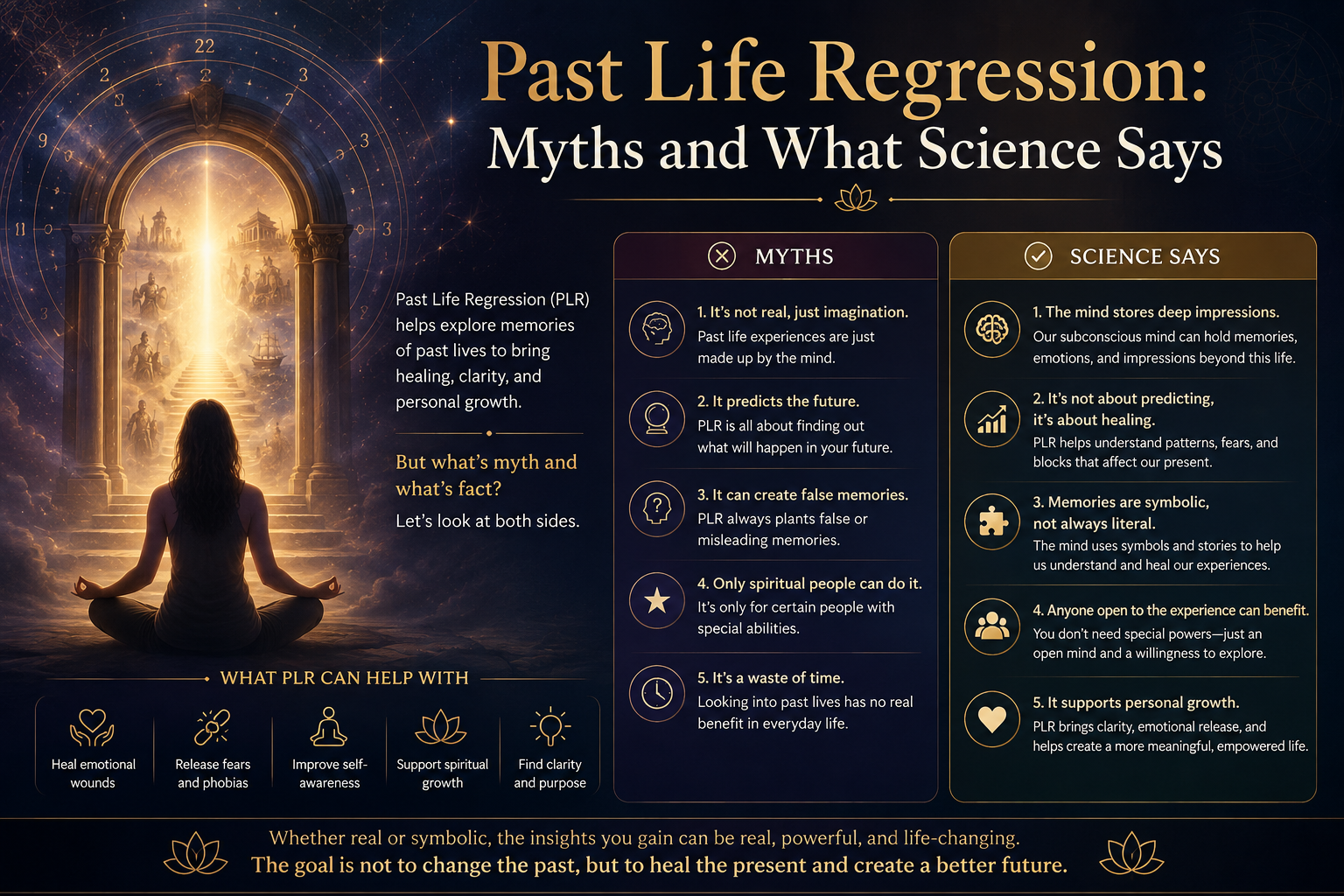
Past Life Regression is a topic that often creates curiosity, fascination, and sometimes confusion. Some people see it as a spiritual practice that can help them understand unexplained emotions or recurring patterns, while others question whether memories experienced during regression are actually memories of a previous life.
The truth is more nuanced. Past Life Regression combines elements of guided relaxation, imagination, memory, suggestion, and personal interpretation. While many people report meaningful experiences during sessions, science has not established that these experiences prove the existence of past lives. Understanding the difference between personal experience and scientific evidence is important before exploring this practice.
What Is Past Life Regression?
Past Life Regression is a technique generally conducted through deep relaxation or a hypnotic state. A trained practitioner guides the individual through a series of prompts intended to explore memories, images, emotions, or experiences that may appear to come from another time or lifetime.
During a session, a person may describe a different name, location, family, occupation, or emotional experience. Some people report strong feelings, vivid scenes, or physical sensations while recalling these experiences.
For believers, such experiences may represent memories from a previous life. From a psychological perspective, however, they may also be understood as products of imagination, memory reconstruction, expectations, or suggestion.
This difference in interpretation is at the heart of the discussion surrounding Past Life Regression.
Myth 1: Past Life Regression Scientifically Proves Reincarnation
One of the most common misconceptions is that Past Life Regression provides scientific proof that reincarnation exists.
It does not.
Science currently does not consider regression experiences sufficient evidence to confirm that a person’s images or memories come from an actual previous lifetime. A person may experience something extremely vivid and emotionally powerful, but the intensity of an experience does not automatically establish its historical accuracy.
This does not mean that the experience is meaningless. It simply means that its meaning should be approached carefully.
For many individuals, regression may provide an opportunity for reflection and self-exploration, even when the experience is not treated as literal evidence of a past life.
Myth 2: Every Memory Experienced During Regression Is a Real Memory
Another popular belief is that everything a person remembers during hypnosis must be true.
This is not supported by modern understanding of memory.
Human memory is not like a video recording. Memories can change over time and can be influenced by emotions, expectations, conversations, imagination, and external suggestions. Under hypnosis or deep relaxation, people can become highly focused and may experience vivid mental imagery.
As a result, a person can genuinely believe that an experience happened without the experience necessarily being historically accurate.
This is why responsible practitioners should avoid telling clients what they are “supposed” to remember or giving leading suggestions that could influence the experience.
Myth 3: Past Life Regression Is the Same as Hypnotherapy
Past Life Regression may use techniques associated with hypnosis, but it should not automatically be considered the same as evidence-based clinical hypnotherapy.
Hypnotherapy can be used in certain therapeutic settings for issues such as relaxation, anxiety management, habit change, and pain management, depending on the practitioner and clinical context.
Past Life Regression, on the other hand, focuses specifically on experiences interpreted as memories from previous lives.
The two practices can overlap in technique, but their goals and interpretations can be very different.
What Does Science Say About Regression Experiences?
Science offers several possible explanations for experiences reported during Past Life Regression.
One explanation involves suggestibility. People can become more responsive to suggestions when deeply relaxed or highly focused. If a practitioner asks questions that imply a particular type of answer, the person may unconsciously create details that fit the suggestion.
Another explanation is cryptomnesia, where a person remembers information but forgets where it originally came from. For example, someone may have encountered a historical name, place, story, or image years earlier and later experience it as something that seems unfamiliar.
There is also the role of imagination and memory reconstruction. The brain can combine fragments of memories, emotions, dreams, stories, and expectations into experiences that feel remarkably real.
None of these explanations necessarily invalidate the personal meaning of a regression experience. They simply offer alternative ways of understanding what may happen during a session.
Why Do People Find Past Life Regression Meaningful?
If science cannot confirm past-life memories, why do so many people find Past Life Regression valuable?
For some, the answer may be emotional rather than historical.
A regression session can encourage people to slow down, focus inward, and think about experiences they may normally avoid. The imagery or stories that emerge can sometimes help individuals reflect on relationships, fears, emotional patterns, or unresolved feelings.
For example, someone who repeatedly experiences fear around a particular situation may explore that fear through symbolic imagery during a session. Whether the imagery represents a literal past life or the person’s subconscious mind is open to interpretation.
The important part may be what the experience helps the individual understand about their present life.
Past Life Regression and Personal Growth
When approached responsibly, Past Life Regression can be viewed as a form of personal exploration rather than a method for proving historical events.
People may use the experience to ask questions such as:
- Why do I keep repeating certain emotional patterns?
- Why does a particular situation affect me so strongly?
- What fears or beliefs are holding me back?
- What can I learn from the emotions that arise during the session?
- How can I develop greater self-awareness?
These questions can encourage reflection and emotional awareness.
However, Past Life Regression should not replace professional medical or psychological treatment. People dealing with serious mental health concerns, trauma, or medical conditions should seek appropriate support from qualified healthcare professionals.
How to Approach Past Life Regression Responsibly
Anyone considering Past Life Regression should maintain an open but balanced mindset.
It is perfectly reasonable to be curious about spiritual experiences while also recognizing the limitations of scientific evidence. A responsible practitioner should not guarantee that a person will discover a specific past life or claim that every experience is historically factual.
The session should ideally focus on the individual’s experience, emotions, and personal reflection rather than forcing a particular interpretation.
It is also important to remember that different people may experience regression differently. Some may visualize detailed scenes, while others may experience emotions, sensations, symbols, or very little imagery at all. There is no single “correct” regression experience.
The Balanced View
Past Life Regression exists at the intersection of spirituality, personal belief, psychology, and guided relaxation. Spiritual traditions may interpret regression experiences as evidence of reincarnation, while psychological perspectives may explain them through memory, imagination, suggestion, and the workings of the subconscious mind.
At present, science does not provide conclusive evidence that Past Life Regression can recover factual memories from previous lives. At the same time, people can have powerful and meaningful experiences during these sessions.
The most balanced approach is therefore to respect the individual’s experience without presenting an unproven interpretation as scientific fact.
Final Thoughts
Past Life Regression continues to attract people because it raises fascinating questions about memory, consciousness, identity, and the possibility of experiences beyond our current understanding.
Whether someone views regression as a spiritual journey, a form of guided introspection, or simply an exploration of the imagination, approaching it with curiosity and critical thinking is important.
The real value of the experience may not always be in proving who someone was in another lifetime. Instead, it may lie in helping them reflect on who they are today, understand their emotions, and discover new perspectives on their personal journey.
Ultimately, Past Life Regression is best approached with an open mind, realistic expectations, and a clear understanding of the difference between a deeply meaningful personal experience and scientifically established evidence.